
Remount RoundupIssue 17
Ten thousand cars, a million rides a week
Who runs a robotaxi, where, and how many. Roughly nine thousand cars and about a million paid rides a week, most of them in fourteen US metros and four Chinese cities.
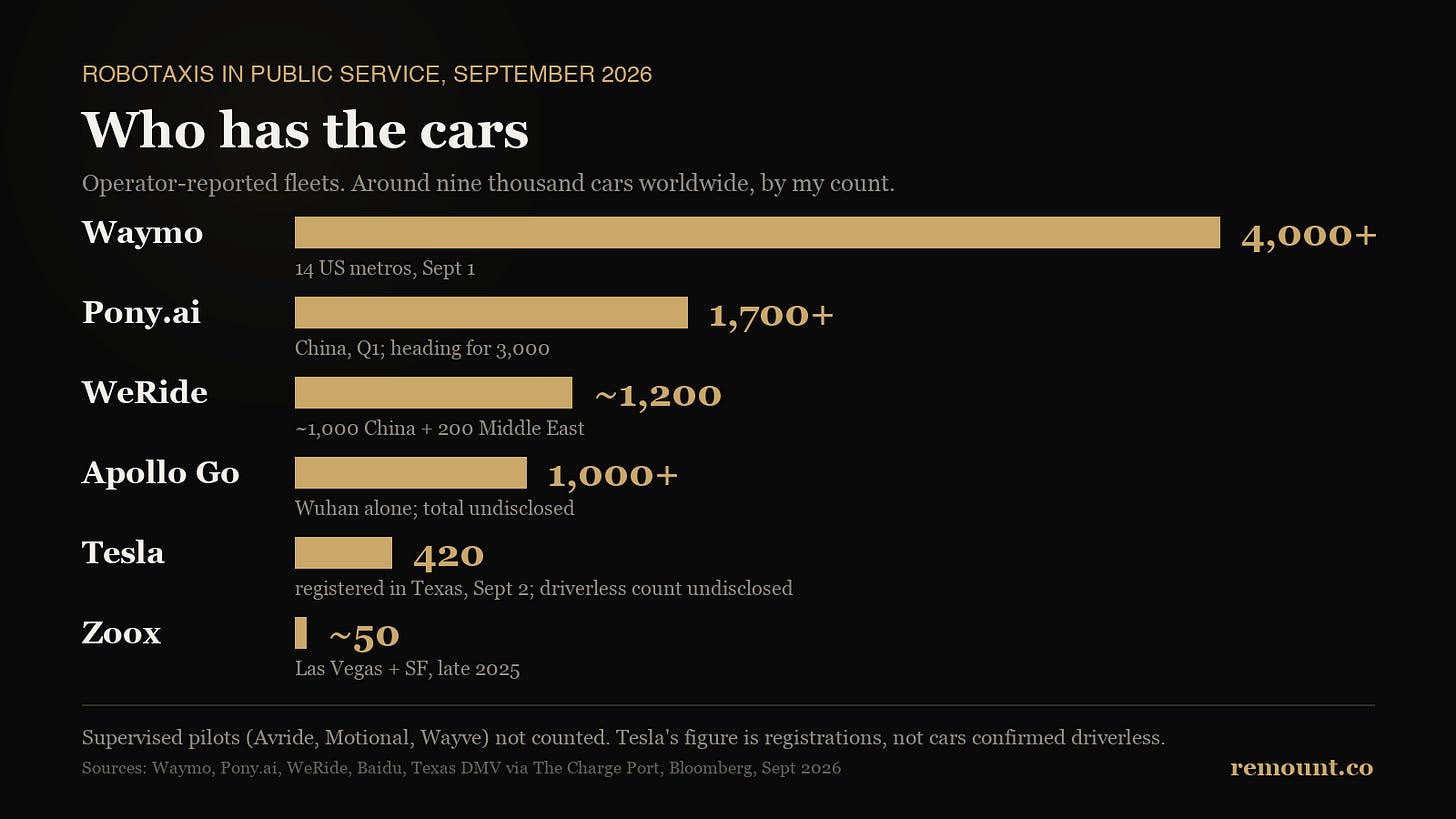
I keep a spreadsheet of who is actually carrying paying passengers with nobody in the driver’s seat. This week I sat down and added it up, operator by operator, from what each of them has said on the record. The total surprised me, and the shape of it surprised me more.
By my count there are somewhere around nine thousand robotaxis in public service in the world right now, and they are doing on the order of a million paid rides a week. Almost all of that sits in two countries. In the United States it is fourteen metros, and in China it is four tier-one cities plus Wuhan. Everywhere else is a pilot, a permit, or a press release.
Start with the United States. Waymo said on September 1 that it has more than 4,000 cars on the road, and it opened Denver, San Diego and Tampa to the public that day, its fourteenth city. It is still reporting more than 500,000 paid rides a week, about four million autonomous miles a week, and it has told investors it expects to pass a million rides a week by the end of the year. In July the Insurance Institute for Highway Safety published the first independent per-mile benchmark of a driverless fleet: across fifty million Waymo miles in four cities, 68 percent fewer police-reportable crashes than the humans driving the same streets in the same years. The exception was Austin, where the sample was small and the result was no better than human. I mention it because it is the honest reading of the study, and because Austin is where the other fleet lives.
Tesla’s Robotaxi runs in seven metros now: Austin, Dallas and Houston, then Miami, Orlando and Tampa since July, all without a safety driver, plus the Bay Area with one on board because California requires it. Texas registration records showed 420 autonomous Teslas on September 2, 375 Model Ys and 45 Cybercabs, and the Cybercab, the one with no wheel and no pedals, has been carrying the public in a slice of Austin since September 4. Tesla does not say how many of the 420 run driverless on a given day. Nevada has authorized up to 5,000 vehicles in Clark County; nothing has started there yet. Behind those two are the ones you ride with a person still sitting up front: Avride with Uber in Dallas, past 100,000 rides, and Motional with Uber in Las Vegas, both promising to pull the operator out later this year. Zoox, the Amazon one with no front or back, started charging fares on the Strip in August after carrying close to a million people for free across four cities.
Now China, which most American readers underrate. Baidu’s Apollo Go runs in about twenty cities, has more than a thousand cars in Wuhan alone, and passed 100 million cumulative rides in the first half of this year; its weekly volume peaked above 350,000 fully driverless orders in March. Pony.ai had more than 1,700 cars at the end of the first quarter, is the only operator driverless in all four tier-one cities, and says it will pass 3,000 this year. WeRide has about a thousand in China and calls itself present in more than thirty cities worldwide. Put the three together and China’s fleet is in the same league as Waymo’s, spread across more companies and more cities.
The third layer is the export wave, and it is almost entirely Chinese technology riding on Uber’s app. WeRide and Uber have run fully driverless, fare-charging service in Abu Dhabi since November and in Dubai since March 31, with Riyadh behind them and a commitment to 1,200 cars across the Gulf by 2027. Apollo Go is in the Gulf as well. In Europe, Wayve and Uber put the first robotaxis on London’s streets on September 3, with Waymo and Apollo Go both preparing London trials; Momenta and Uber are due in Munich, WeRide in Madrid, Pony with Stellantis in Luxembourg, and Apollo Go with Swiss Post in Zurich. In Asia, WeRide and Grab are carrying passengers in Singapore’s Punggol district, and Apollo Go has opened in Seoul. Tokyo is on Waymo’s list.
Step back and three models are running the same race. Waymo and Apollo Go build the car, own the car and run the network. Uber, Lyft and Grab own no cars and rent the demand to whoever shows up with supply, which today means a Chinese company in most of the world and Waymo in Austin and Atlanta. Tesla is the only one that builds the car and says out loud that it wants other people to own the ones in its fleet.
Which brings me to the number that is not on any operator’s slide. Of those nine thousand cars, I cannot find one that belongs to an individual. Every robotaxi carrying the public today is on a corporate balance sheet or in a fund. That is the gap Remount exists to fill: the first fleet form we filed, on September 3, carried nearly 300 prospective owners, most of them wanting one to five cars. The map above says the machines work. Who gets to own them is still open.
Regards,
Jonas
Autonomy roundup: the week’s evidence
Waymo opened Denver, San Diego and Tampa on September 1, its fourteenth metro, and put its fleet above 4,000 cars. Still more than 500,000 paid rides and about four million autonomous miles a week; the stated goal is a million rides a week by the end of 2026. Las Vegas remains employee-only. TechCrunch, The Charge Port tracker.
Texas records show 420 registered autonomous Teslas as of September 2: 375 Model Y and 45 Cybercab. The controls-free Cybercab joined the public Austin fleet on September 4. Nevada authorized up to 5,000 vehicles in Clark County on August 20; service there has not begun. Tesla does not disclose how many cars run driverless. The Charge Port, Teslarati.
IIHS published the first independent per-mile crash benchmark of a driverless fleet on July 23. Across 50 million Waymo miles in San Francisco, Los Angeles, Phoenix and Austin, 68 percent fewer police-reportable crashes per mile than human drivers in the same cities and years; 85 percent fewer single-vehicle crashes; 81 percent fewer injury crashes. Austin’s small sample showed a slightly higher rate. IIHS, Axios.
Zoox began charging for rides on the Las Vegas Strip on August 10 with NHTSA’s permission, after carrying nearly a million free riders across Las Vegas, San Francisco, Austin and Miami. CNBC, Fox5 Vegas.
Wayve and Uber put the first robotaxis on London’s streets on September 3, a small fleet of Ford Mustang Mach-Es with Wayve’s software, as Waymo and Baidu’s Apollo Go prepare their own London trials and the EU moves to speed up approvals. BNN Bloomberg, Euronews.
WeRide and Uber run fully driverless, fare-charging robotaxis in Dubai since March 31 and in Abu Dhabi since November, with Riyadh behind them and a joint commitment to at least 1,200 robotaxis across the Middle East by 2027. WeRide has more than 200 cars in the region. Uber, WeRide.
Baidu’s Apollo Go passed 100 million cumulative rides in the first half of 2026, runs in about twenty Chinese cities, and has more than 1,000 cars in Wuhan alone. Pony.ai reported a fleet above 1,700 in the first quarter and is targeting more than 3,000 this year; WeRide reports about 1,000 in China. CnEVPost, China Daily.
Reader question: which city on this map do you expect to be riding in first, and which one would you want to own a car in? Reply and tell me. The answers shape where we point the next fleet form.
Run your own numbers on what a robotaxi earns: remount.co/modeler
This newsletter is general information, not an offer to sell or a solicitation of an offer to buy any security. Any offering Remount conducts is made only to verified accredited investors through definitive documents under Rule 506(c). Forward-looking statements are estimates, not promises.