
Remount RoundupIssue 18
How much does it cost to build and operate a depot?
What we know, what we think, and what we still have to learn about the cost of a robotaxi depot: building one, running one, and keeping a car in one.
Every robotaxi on the road goes home at night to a building someone paid for. In Nashville, Waymo’s cars will sleep in an 80,000 square foot depot that Lyft’s Flexdrive opens in October, staffed by more than 70 technicians and coordinators. Tesla’s own plans sit in the permit files. In May a Supercharger watcher on X, MarcoRPi1, turned up Clark County filings for a 36,000 square foot “Cybercab Phase 2” building on Mohawk Street in Las Vegas, with cleaning bays, an indoor wash enclosure and tire service, and zoning documents in Irving, Texas for a 35,000 square foot site to store, service and repair an autonomous fleet, with 276 parking spaces.
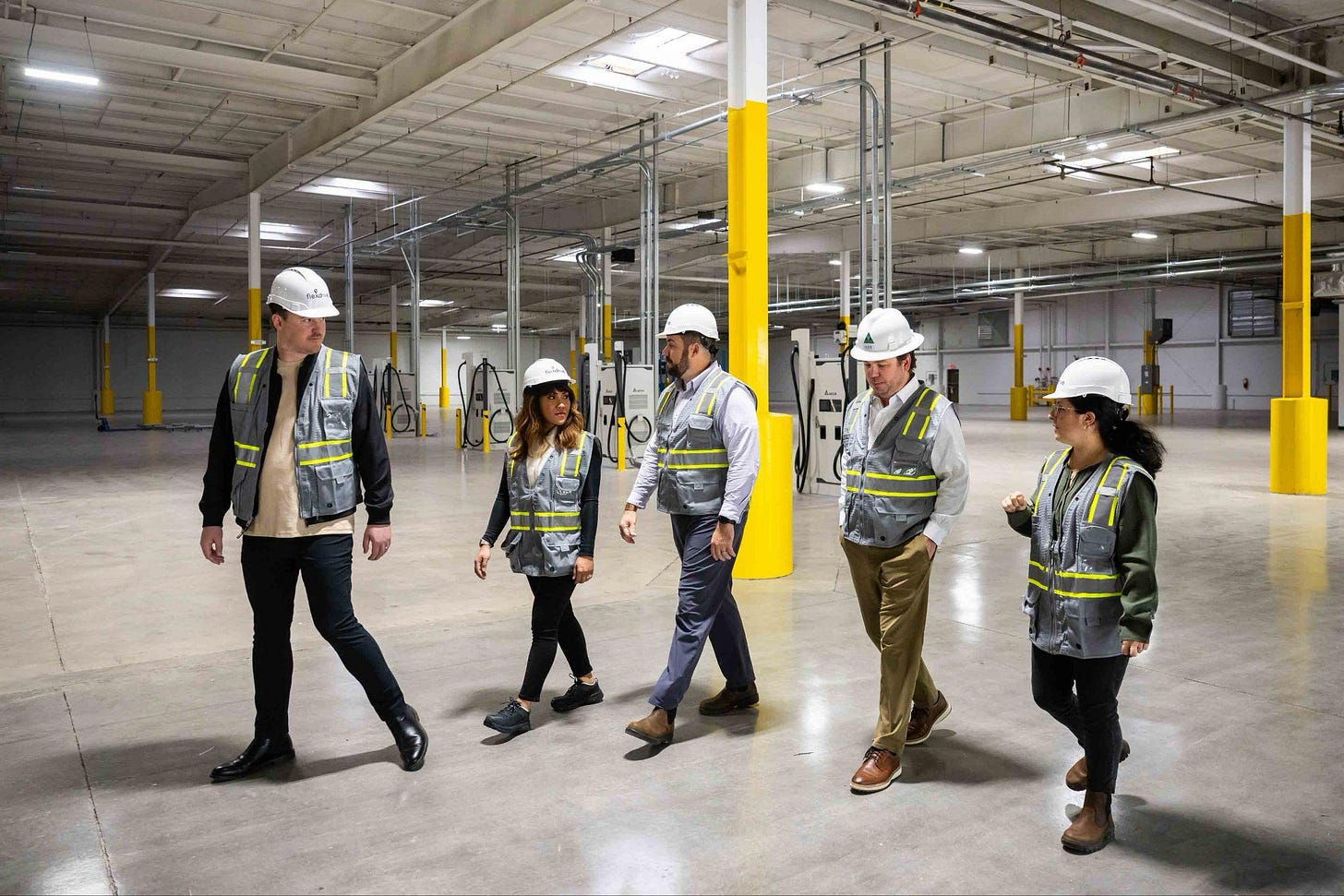
Flexdrive by Lyft’s 80,000 square foot Waymo depot in Nashville, during construction. Photo: Lyft.
Across the emerging robotaxi ecosystem there are lots of guesses and very little public data, and the reality is that depot costs will decide a lot about whether the cars make money.
So this week I want to lay out what we know about depot costs, what we think, and what we still have to find out. Remount can’t be a real fleet partner in a city without knowing there is a place to park, charge, clean and maintain our cars.
The data in this essay comes from a variety of sources. I have spoken with several teams working on depot strategies across the Cybercab ecosystem, and we have done our own research in a number of these areas. If you are working in this space, I would love to talk with you too, so we can compare numbers and keep iterating on what the right depot strategy looks like.
One point of clarity first. Almost everyone in the ecosystem believes third parties are going to own and operate depots for Cybercabs. Tesla’s own robotaxi interest form, launched on September 3, asks whether you want to buy fleet vehicles or build mobility hubs and infrastructure, and a company that keeps its balance sheet light has every reason to want partners on the buildings. For this issue I have used Austin as the hypothetical location, although in all likelihood Remount and just about every other Tesla partner will be building depots somewhere other than Austin.
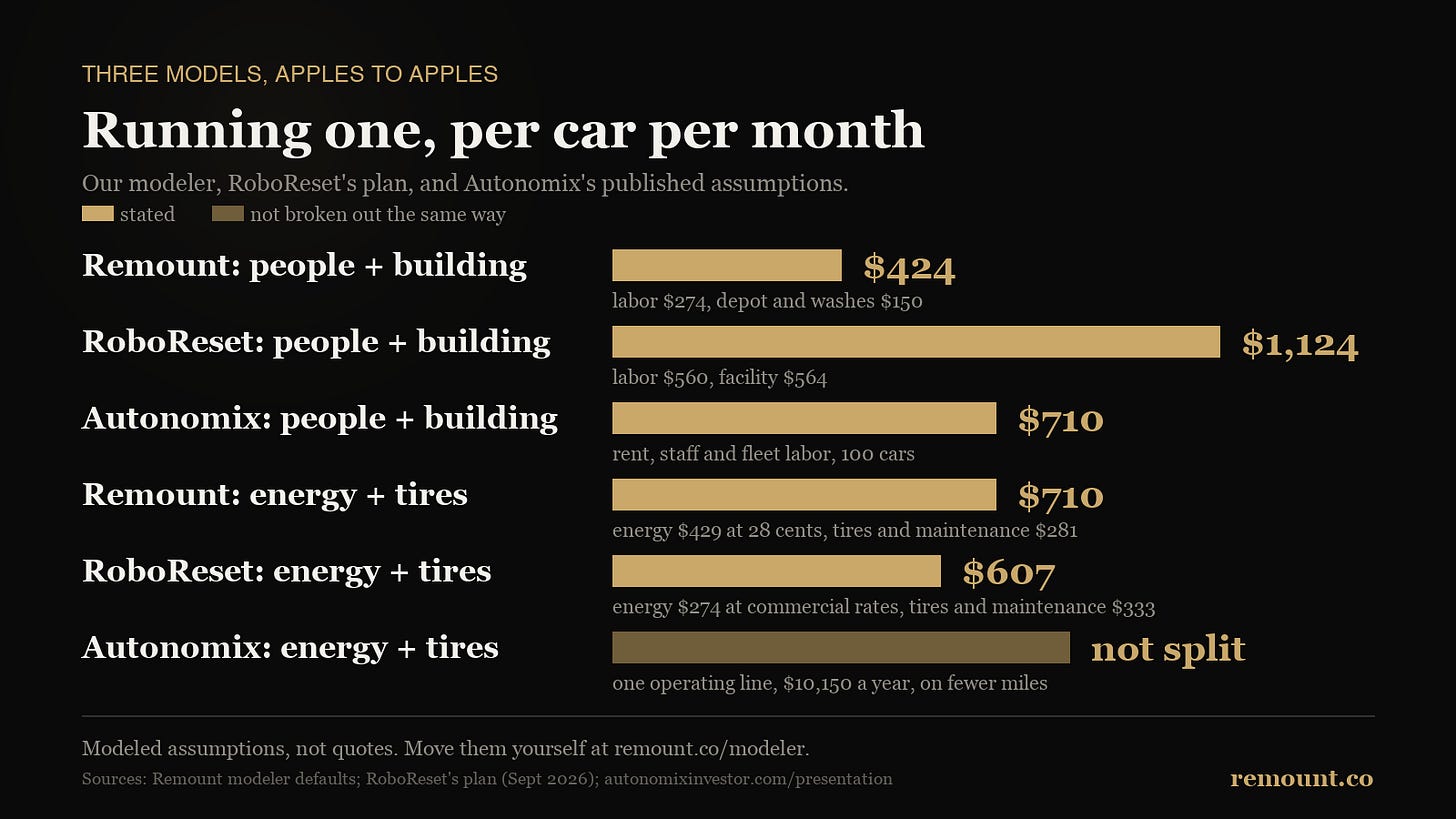
Building a robotaxi depot. Some of the pieces have prices you can look up. A Level 2 charging port runs roughly $5,000 to $15,000 installed, and depending on the locale you may find government incentives. A DC fast stall is more like $75,000 to $150,000, before you pay to bring power to it. Surface parking in Austin rents for $50 to $150 a space a month. Our own model puts about $2.5 million on leased land for eight fast stalls, two dozen Level 2 ports, a wash bay and two light-service bays, enough for about 140 cars on a charge-and-clean cycle. That is the cost to build the thing, with a 15 percent contingency and before any legal fees or opening cash, and the line-by-line is below. Between the bull and bear cases for charger prices and the utility upgrade it runs from about $2.1 million to $3 million.
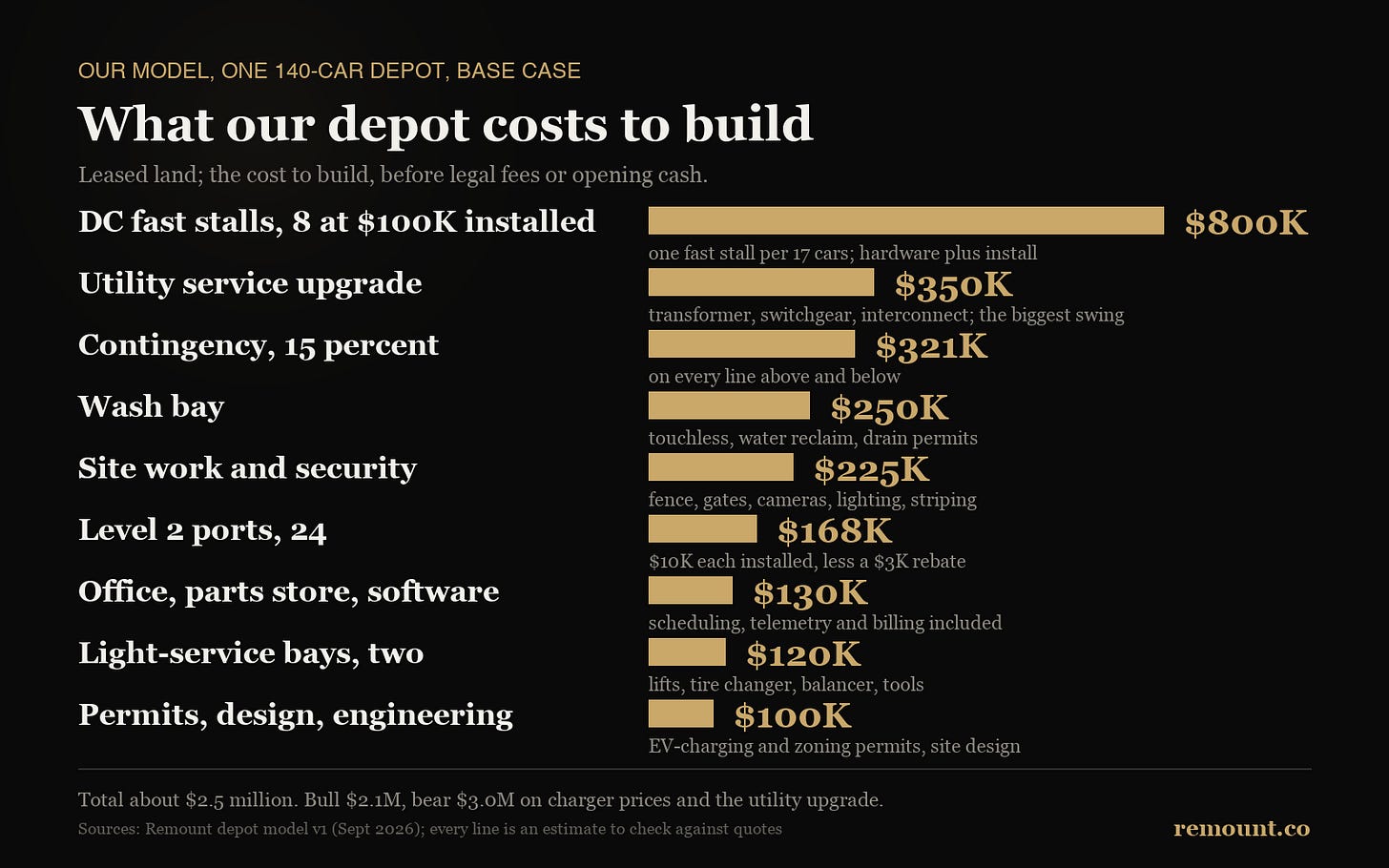
Andy Shelley, who is building RoboReset in Austin to clean, charge and redeploy robotaxis, shared a plan that puts a 100-car depot at $600,000 to $1.5 million before land, with power, chargers and site work as the swing. Autonomix’s published plan is lighter still: one Level 2 charging pad per three cars at $8,000 installed, about $270,000 for 100 cars, on rented space at $4 a square foot, with no fast charging at all. I compared notes with Taylor Nielsen, who runs Autonomix, this week, and his reasoning is simple: he models a car carrying a paying passenger 22 to 26 percent of the day, Waymo’s range, so it is parked most of the time and slow charging is enough. Our modeler runs the car fourteen hours a day, which is why I carry some fast charging. The two of us disagree on utilization, and that single number decides how much the building costs. What I can’t price yet is the power. Interconnects, transformers and the months you wait for them are the line that swings.
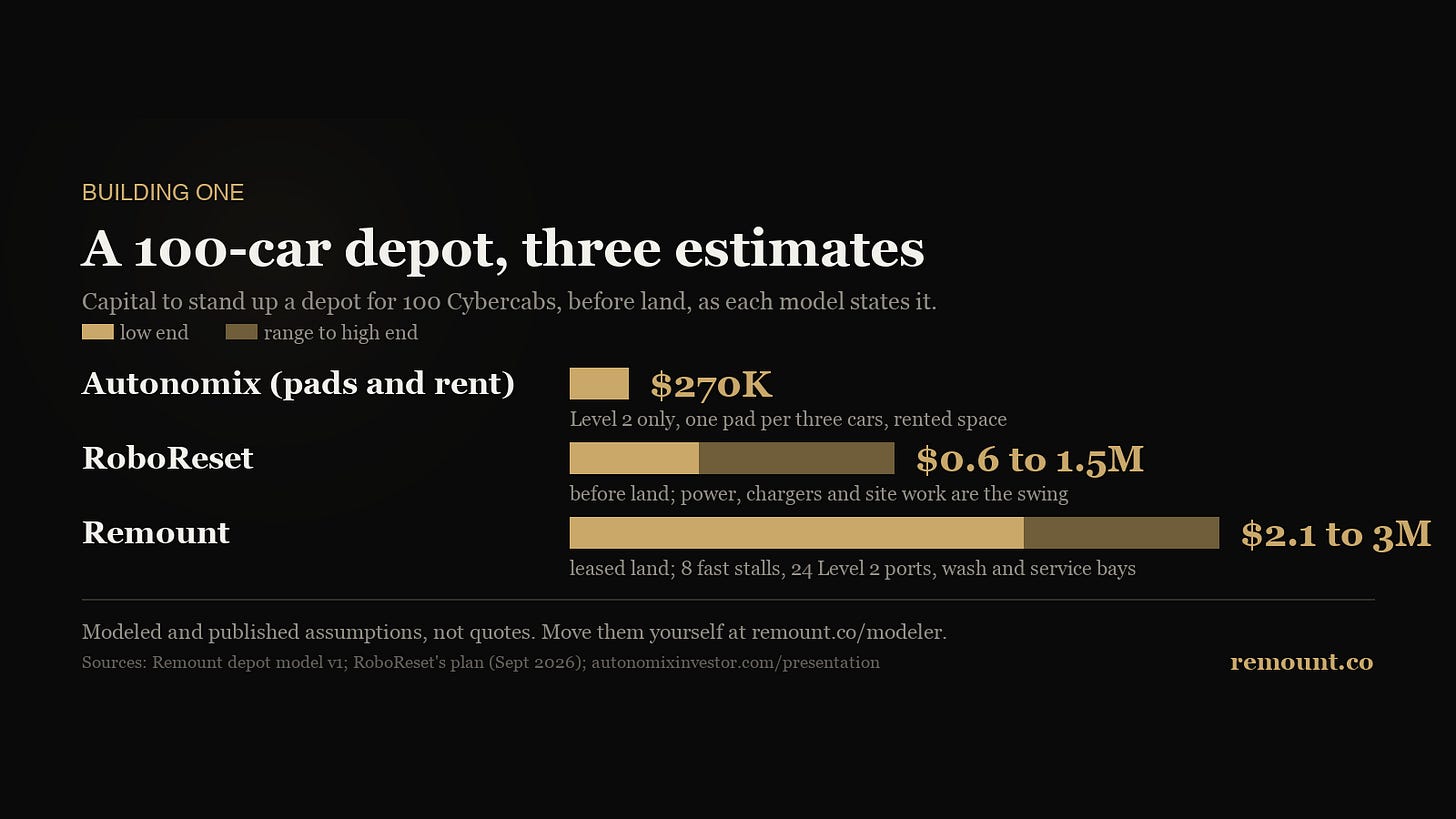
Running a robotaxi depot. This is where our own numbers are softest, so here is the comparison apples to apples, per car per month, across three models: our modeler, RoboReset’s plan, and Autonomix’s published assumptions.
People and building first. Our modeler carries $274 for charging and cleaning labor and $150 for depot, parking and washes, $424 in all, and I have said before those two lines are round allowances rather than anyone’s actual costs. RoboReset’s plan comes in at $1,124 for the same two lines: $560 of labor, built up from twenty minutes per reset at $25 an hour loaded and 45 to 60 visits a month, plus $564 of facility, which is rent, charger payments, buildout recovery, depot insurance, wash supplies and administration. Autonomix carries $120,000 a year of rent and $332,800 of staff for a 100-car depot plus $4,000 a car of fleet labor, which works out to about $710. So on the part of the depot that is people and building, our number is the low one by a wide margin, and the honest range today is $424 to $1,124.
Energy, tires and maintenance second. Our modeler carries $429 of energy, at 28 cents a kilowatt hour that I set close to retail fast charging on purpose, and $281 of tires and maintenance, $710 together. RoboReset prices depot power at Austin’s commercial rate, 7 cents a kilowatt hour plus a demand charge, and lands at $274 of energy and $333 of tires and maintenance, $607 together. Autonomix runs fewer miles and folds tires, maintenance and the rest into a single operating line of $10,150 a car a year, so it does not split the same way. Power pushes the other way from people and building: our July research on Austin’s commercial tariff put managed Level 2 charging at 11 to 14 cents a kilowatt hour all in, so a depot that owns its meter gets some of that back.
What we need to learn is mostly labor, and labor is visits times minutes. A car running 14 hours a day needs about a charge and a half. Does every stop need a person inside the car for twenty minutes, or can a charge-only stop at a lighter site skip the full reset? Triage on arrival could change that line a lot. So could knowing which jobs Tesla keeps, like dispatch and the first call after a crash, and which fall to the owner. The biggest unknown is who owns the building at all. If Tesla builds the depots and partners only need a place to park, Taylor’s words, then most of this cost moves onto Tesla’s balance sheet and a fleet partner’s depot becomes a leased lot. Nobody I have talked to has heard from Tesla on that question, and every one of us is planning to solve land and electricity the day an allocation names a city.
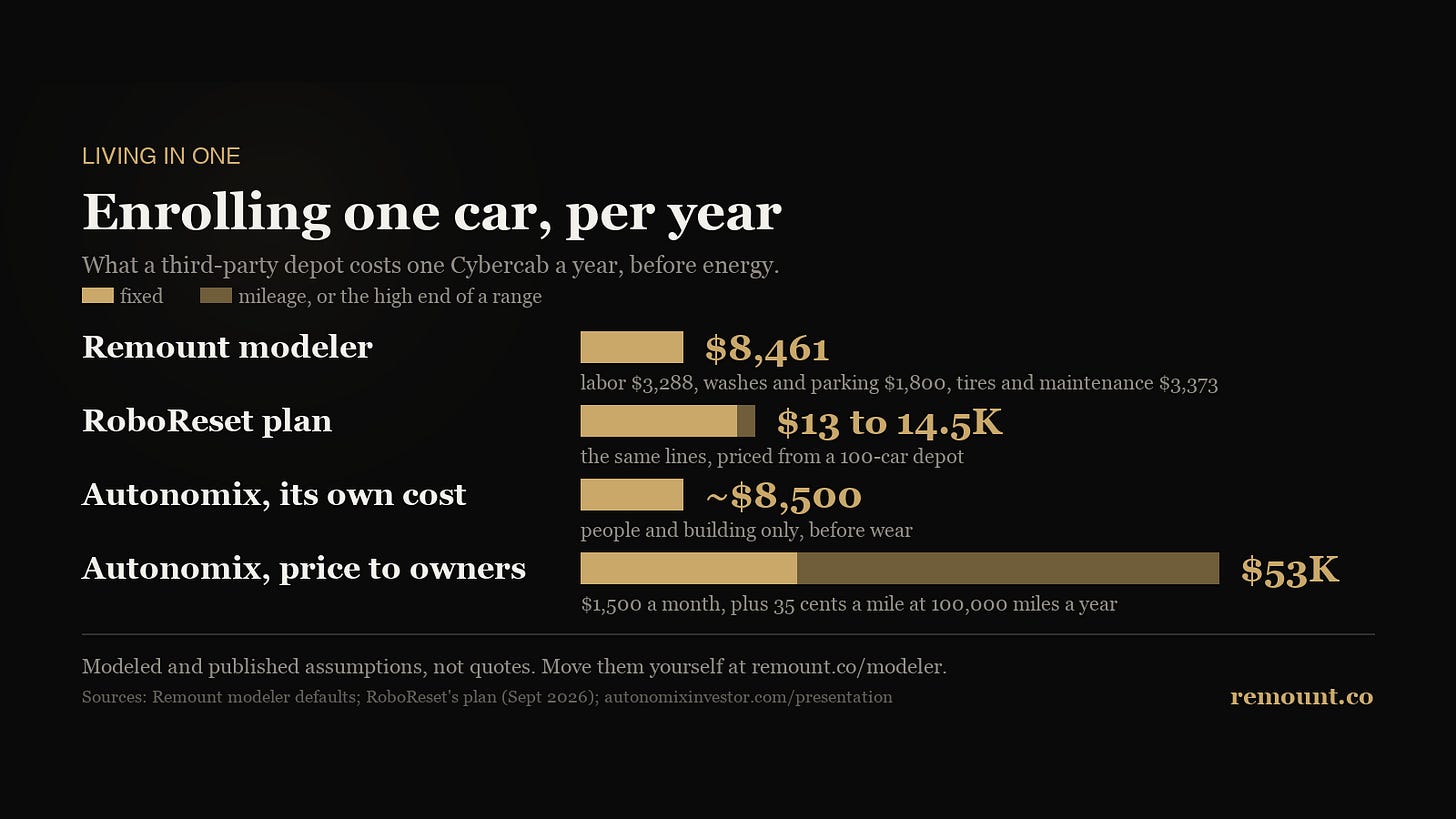
Enrolling your Cybercab in a third-party depot. From the owner’s side a depot isn’t a building. It’s a line on the statement. As it stands, our model says it costs about $8,461 a year to enroll one of our Cybercabs in a third party’s depot (labor, washes and parking, tires and maintenance), plus its energy, and the modeler shows every line. The other data sources anticipate charging more than that: RoboReset’s plan puts the same lines at about $13,000 to $14,500 a year, and Autonomix’s own people-and-building cost is about $8,500 a car a year before energy and wear, while its published price to outside owners is $1,500 a month plus 35 cents a mile. There is a lighter version worth pricing: Superchargers and third-party chargers, local car washes that take autonomous cars, a portable charger for a car that runs low, garages instead of fenced lots. Someone I spoke with this week described the future depot as something like a car wash within range of the car. I’d like that to be right.
Here is why we are doing the work in public. When Taylor and I put our two models side by side, we found the same range for Tesla’s take, similar operating lines, and the same admission that neither of us has heard a word about allocations. My phrase for it was that at least we are all hallucinating the same assumptions. The way out of that is data, and the only way to get it is to say the numbers out loud and let people who run yards, garages and car washes correct them. To earn a place as one of the fleet partners Tesla trusts in a city, we have to know what a depot costs better than anyone selling us one, and every number we pin down now is a number the depot side of Remount will use when we build.
Regards,
Jonas
Autonomy roundup: the week’s evidence
Waymo opened Las Vegas to the public on September 14, its fifteenth metro and eighth state. It starts with “dozens” of the new Ojai minivans on the Strip south of Highway 589 into Boulder Junction, onboarding riders from a waitlist above 100,000. Zoox has charged fares on the Strip since August 10. https://techcrunch.com/2026/09/14/waymo-opens-robotaxi-service-in-las-vegas/ https://www.fox5vegas.com/2026/09/14/waymo-launches-robotaxi-service-las-vegas/
Waymo, the taxi operator Nihon Kotsu and the GO app said on September 14 they intend to open driverless rides in Tokyo in 2027, starting small and building to about 100 cars, bookable in both apps. Waymo says the date depends on national and local approvals and on finishing validation of the technology and the joint operations. Nihon Kotsu’s trained crews have supervised the cars on Tokyo streets since 2025. https://waymo.com/blog/2026/09/opening-tokyo-in-2027-with-nihon-kotsu-go/ https://www.arabnews.jp/en/business/waymo-japanese-partners-target-driverless-taxi-service-in-tokyo-in-2027-3000139
Bolt and Lucid announced on September 17 that Bolt aims to put at least 25,000 Level 4 Lucid EVs on its network in Europe, on Lucid’s coming Midsize platform with NVIDIA’s Hyperion architecture. Bolt says it will build the fleet infrastructure and own and operate the fleet itself. There is no order, no dollar figure and no deployment date yet, and the Midsize platform was delayed in August. https://electrek.co/2026/09/17/lucid-bolt-25000-autonomous-evs-europe/ thedriverlessdigest.com
Reader question: if you have run a fleet yard, a parking garage or a car wash, what did I get wrong? Reply and tell me. The depot numbers are the ones I most want corrected by someone who has done it.
Move the depot lines yourself and see what changes: remount.co/modeler
This newsletter is general information, not an offer to sell or a solicitation of an offer to buy any security. Any offering Remount conducts is made only to verified accredited investors through definitive documents under Rule 506(c). Forward-looking statements are estimates, not promises.