
Remount RoundupIssue 16
Who should own the first 50,000 Cybercabs?
Tesla opened a form for fleet buyers. We filed it for nearly 300 prospective owners. The case for why Tesla should want that, with the numbers.

I filed Tesla’s robotaxi fleet form on September 3, the day the Cybercab launched in Austin, and followed up on September 9 with the business case attached. Both times I filed it for one company, Remount, and behind that company sit nearly 300 people who registered on remount.co to own a Cybercab. Most of them want one to five cars. None of them can run a fleet. That is the whole idea.
This issue is different from the usual Roundup. No links this week. One argument, some original research, and a favor to ask at the end.
Elon said it first
The idea that regular people would own the cars on Tesla’s network is not ours. It is Tesla’s, and it is older than most of the company’s product line.
Master Plan, Part Deux, July 2016: you will be able to “add your car to the Tesla shared fleet just by tapping a button,” and Tesla would run its own cars only “where demand exceeds the supply of customer-owned cars.” Autonomy Day, April 2019: “any customer will be able to add or remove their car,” with Tesla taking a cut, the way Uber and Airbnb do. The Q1 2024 call: “think of it as combination of Airbnb and Uber.” We, Robot, October 2024, about the Cybercab: “you will be able to buy one.” The Q4 2025 call this January: existing owners will be able to “add or subtract their cars to the fleet.” And in February, asked on X whether Tesla would sell a Cybercab to a customer for $30,000 or less before 2027, Elon answered with one word. Yes.
Then on September 3 Tesla put up a page that says “Help Us Build Our Robotaxi Network” and a form with one interest type: Cybercab fleet vehicle purchasing. It asks for a company name. It does not ask how many people are behind the company.
So the question is not whether people will own the cars. Tesla has said so for ten years. The question is what shape that ownership takes when the first 50,000 Cybercabs roll out of Giga Texas. Fifty thousand is about five months of the Cybercab line at the rate Tesla has published, and about twelve times the fleet Waymo runs today. It is the number that decides the shape of the industry.
Two ways to fill 50,000 cars
There are two ways to put 50,000 Cybercabs on the road.
The first is a handful of large operators. Three to five balance sheets, fund-backed or corporate, each holding ten thousand cars. This is the path of least resistance for any manufacturer. Few contracts, big checks, one throat to choke.

The second is the path Tesla described in 2016: thousands of owners. Individuals with one or two cars. Small businesses with five or ten. Families, dentists, the guy who already runs a detailing shop. Using public data on how small fleets are distributed, that is roughly 19,000 owner households and small businesses behind the same 50,000 cars. The range depends on the mix, from about 11,000 if most cars sit in 20-car blocks to about 24,000 if most owners hold one or two.
The cars are identical. The software is identical. Tesla holds the app, the dispatch, the pricing and the rider either way. The only thing that changes is who owns the asset and where the money goes after the car has paid its bills.
What stays in the city
Here is the part we spent the week on.
A robotaxi earns money in a city. Under concentrated ownership, what is left after operating costs and financing goes to the operator’s investors, wherever they are. Under distributed ownership, it goes to a household or a small business in the city where the car runs, and most of what a household earns gets spent close to home. Local-ownership studies put the share of a dollar that recirculates locally at roughly half for an independent business versus about one seventh for a chain. Those studies measure retail, not car fleets, so we used them as brackets, not as the answer.
On public assumptions about fares, utilization, costs and loan rates (Tesla’s stated price intent, Tesla’s Austin fares, Waymo’s published mileage, the analysts’ cost-per-mile estimates, Fed auto-loan rates), the first 50,000 Cybercabs produce a residual pool of about $640 million a year in a base case. Under concentrated ownership, about $30 million of that stays in the ten metros where the cars run. Under distributed ownership, about $350 million does. Call it $320 million a year that stays in Dallas, Houston, Austin, Miami, Phoenix, Las Vegas, the Bay Area and the rest, instead of leaving.
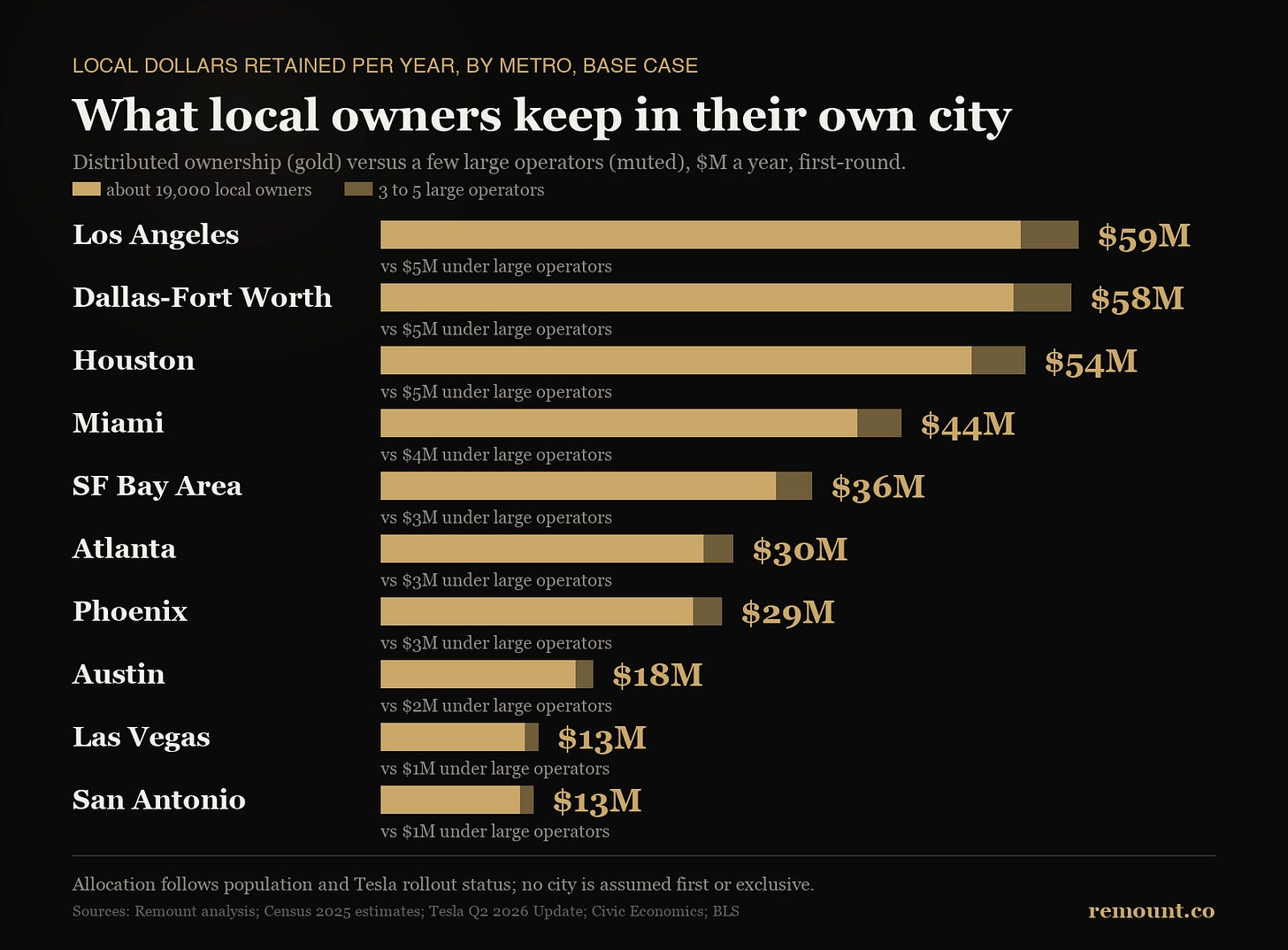
Two things to say about that number. It is first-round money; we did not apply a multiplier, and an economist would. And in the low case, where fares fall to where Tesla’s long-run pricing talk sits, nothing clears the loan and there is no residual to fight over. That is true for a big fleet and a small one alike. The structure matters more than the spreadsheet, which is exactly why the structure is worth arguing about now, before the spreadsheet is settled.
Jobs come out the same either way. Fifty thousand cars need something like 4,000 people to charge, clean, inspect and maintain them. The difference is who employs them. In the distributed model that work goes to local depot partners in each city, which is how Remount runs it.
The risk to Tesla of concentrated fleet ownership
Concentrated ownership has a risk that does not show up in a unit-economics model. One buyer can change its mind.
In October 2021 Hertz announced an order of 100,000 Teslas. Elon said the next week that no contract had been signed and that Hertz would pay the same margin as anyone else. Hertz went on to buy about 35,000. In January 2024 it filed an 8-K to sell 20,000 of its EVs, about a third of the fleet, and took a $245 million charge. In April it raised that to 30,000 and took another $195 million. Thirty thousand cars came back onto the market inside two years, and nothing about the car had changed. What changed was one company’s rental margins and one company’s repair costs.

Nineteen thousand owners do not do that. They can fail, and some will, but they fail one at a time, on separate loans, with no block sale that resets the price of every Cybercab on the road, including Tesla’s own. A distributed fleet is safer for the asset than a concentrated one, provided the financing is distributed too. The taxi-medallion collapse in New York was not caused by small owners; it was caused by three credit unions holding most of the paper. We built Remount so no single lender holds ours.
Why this is good for Tesla
I am biased, so let me make the case in Tesla’s terms rather than ours.
One counterparty. Tesla’s form asks for a company because Tesla wants one contract, one financing story, one insurance certificate, one depot arrangement. Remount is that company. Owners hold their Cybercabs in their own LLCs. Accredited investors pool through Remount-managed SPVs. Every entity sits under one management agreement, so Tesla sees one fleet.
Owners who are also customers. Every one of our prospective owners is a Tesla customer who wants to be a Tesla advocate. They live in the cities the cars run in. They care how the depot runs and how the network behaves in their town, because they ride it too. A leased corporate fleet does not produce that.
Nothing about the stack changes. Every car runs Tesla’s software and Tesla’s dispatch at Tesla’s prices. Owner participation was Tesla’s design; Remount is the plumbing that makes it work at fleet scale.
Somewhere to send small owners. Tens of thousands of people have filled in Tesla’s form asking for one to five cars. Onboarding them one at a time is a support burden. Turning them away is telling Tesla’s most committed customers no. Tesla can point a small owner to Remount and count their demand inside one fleet entry.
Wherever Tesla opens. We deploy where Tesla opens and wants fleet partners, on Tesla’s schedule. Most of our registered prospective owners told us they will go to any city Tesla chooses.
And three things I cannot prove yet, which a fair reader at Tesla will ask about. Registrations are interest, not orders; the financing lines are being arranged, not closed. The commercial insurance program is in development, not bound. The depot partners in each city are being lined up, not contracted. Every one of those gets answered by execution, and execution starts with a conversation.
The demand Tesla cannot see
We have been keeping count since April, with no ad budget to speak of.

Nearly 300 prospective owners. Seventy-eight percent said they would go wherever Tesla opens. Most of the rest named Austin, Houston and Dallas. About a third already know they want between one and ten cars; the others are still deciding, which is what you would expect before a single fleet term has been published. Ninety-five of them registered in the week of the Cybercab launch, and they have kept coming in every day since.
Tesla can see its own form. It cannot see this, unless someone shows it.

The favor
If you have read this far, you can help in one of three ways.
Share this issue. On X, on LinkedIn, wherever you talk about Tesla. The share buttons below carry a post you can use or change.
If you know someone at Tesla, forward this to them. One person, not a list. The people who decide fleet partnerships read what their colleagues send them.
If you work at Tesla, please help us connect with the teams that can evaluate this opportunity.
To the fleet program team, if this reaches you: we want a conversation. jonas@remount.co.
Jonas
Own the bots that do the work. Rideshare. Delivery. Entertainment.
Share this issue
Pick the one that is true for you and change any words you like. One post is enough. Please do not tag Tesla employees or executives; the point is to be read, not to pile on.
Post on X as a registered prospective owner
Post on X: the 50,000 question
Post on X: send it to someone at Tesla
Share on LinkedIn
Forward to one person at Tesla by email
If you work at Tesla, please consider helping get the Remount story into the right person’s inbox. Thanks!