
Remount RoundupIssue 25
Uber says someone else should own the robotaxis
Uber says outside money should own its driverless fleet. It has 10.8 million drivers and couriers. Start with them.
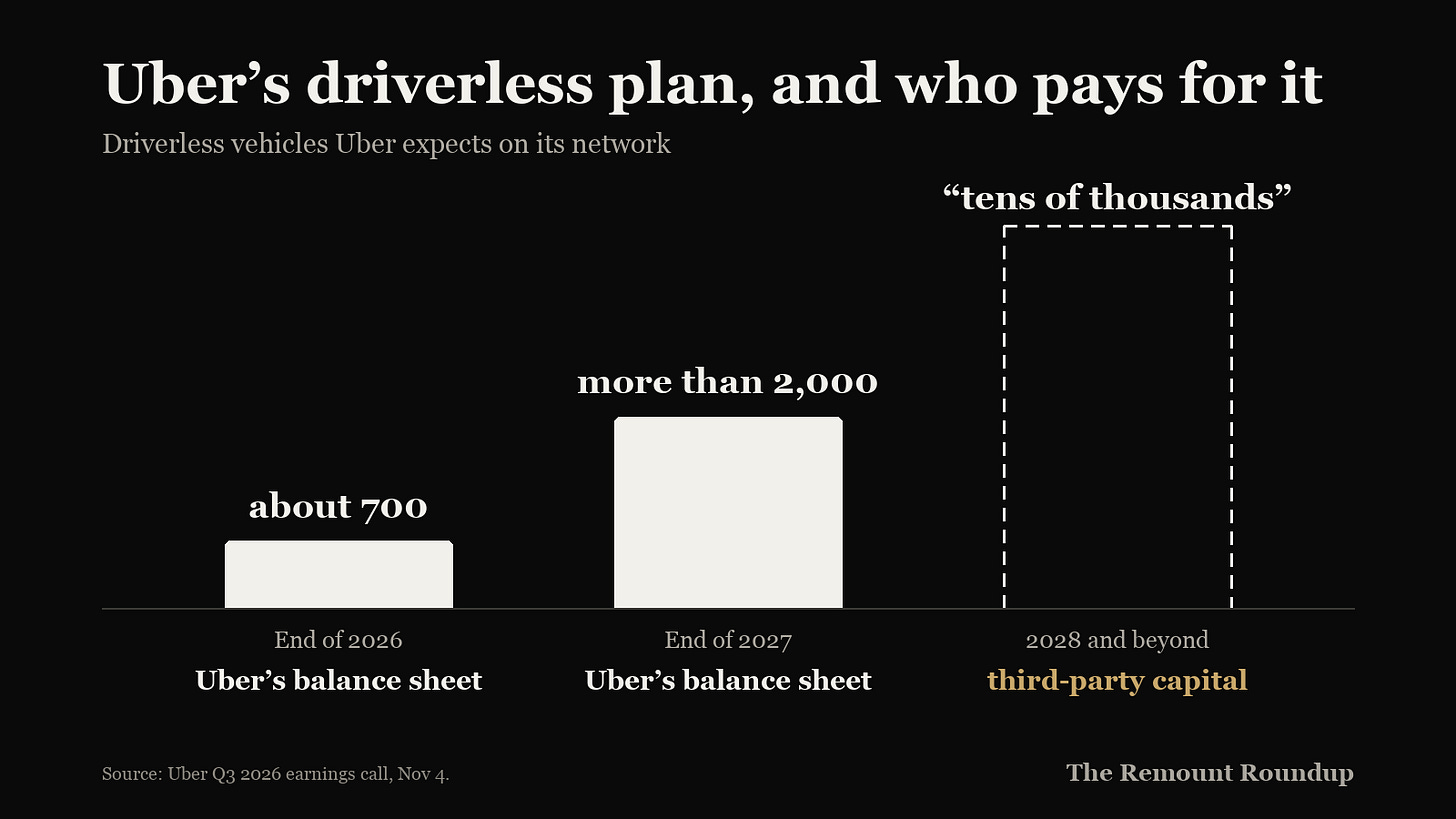
“So our long run expectation is that this should be financed by third party capital, not by Uber’s balance sheet.”
That’s Balaji Krishnamurthy, Uber’s CFO, on the company’s earnings call on November 4. He was talking about the driverless cars on Uber’s network. Uber expects about 700 of them by the end of this year and more than 2,000 by the end of 2027. Dara Khosrowshahi called the real goal “tens of thousands of vehicles in 2028 and beyond.” Uber will carry the early cars on its own books. Past that, it wants someone else’s money to own them.
I started Remount on the idea that robotaxis need owners. It’s a different thing to hear the largest ride network in the world say it on its own call.
Dara said one more thing a lender would want to hear first: “the residual value of the AV vehicles is not established yet.” Nobody knows yet what a used robotaxi is worth. So he expects these fleets to be financed on what they earn, not on what they’d sell for. He also said that if a fleet operator fails, Uber can put the cars under separate ownership and they keep earning on its network.
Read that as a small owner. The car has to earn. If the person running it fails, the car goes to someone else and keeps earning. That is a car as a small business, and it’s the model we’re building Remount around.
The same week, Waymo said it will end its Uber exclusivity in Austin and Atlanta in January 2028 and take bookings in its own app there. Its co-CEO said, “It’s important for us to have that relationship with the rider.” So the platforms are sorting out who owns the rider, and Uber just told us it would rather not own the car.
Then who does? Dara said the financing partners Uber has talked to are quite interested, and that some of them are looking for something besides data centers to put money into. Banks and funds would be first in line.
There’s another group Uber didn’t mention. In its remarks for the same quarter, it said 10.8 million drivers and couriers took home more than $25 billion on its platform. An Uber policy executive said in July that each driverless car displaces roughly four drivers. The people with the most to lose from these cars are the ones nobody has asked to own them.
Uber has tried to put something in drivers’ hands before. In 2015 it leased cars to drivers with poor credit. It lost about $9,000 a car, by the Wall Street Journal’s count, and shut the program two years later. At its IPO in 2019 it paid about $300 million in cash rewards to more than 1.1 million drivers and let US drivers buy up to 5.4 million shares. One made drivers renters. The other was a thank-you. Neither gave a driver a stake in what comes next.
A Plan for Uber Drivers
Here’s what would. A driver puts a few dollars from each trip toward a share of the driverless cars coming onto the same network. Uber matches it. The share is in a pool of cars, not one car, so one bad vehicle doesn’t sink anyone. It stays with the driver after they stop driving. By the time a city’s fleet is mostly driverless, the people who built Uber’s business there own part of it.
It has to avoid the mistake New York cab drivers lived through. They borrowed to buy medallions that peaked around $1 million. The value fell below $200,000 and the debt stayed. A driver’s stake in a robotaxi should be paid in over time, out of earnings, with nothing borrowed against it.
As far as I can find, nobody offers drivers this today. A Lyft executive wrote last year that helping drivers move into owning AVs is central to Lyft’s strategy. Uber has offered drivers paid digital tasks. A bill in Washington, D.C. would tax robotaxi miles and put part of the money into training for drivers. Those help. None of them is ownership.
So here’s a proposal for Uber. Pick one city. Let a few hundred drivers opt in. Match what they put in. Organizing owners like that is what we’re building Remount to do, and I’d like to help. You said the cars need outside owners. Start with the people already driving them.
Jonas
Autonomy roundup: the week’s evidence
Uber says outside money should own its driverless fleet. On its third-quarter call on November 4, Uber said it expects about 700 fully driverless vehicles on its network by the end of 2026 and more than 2,000 by the end of 2027, with “tens of thousands” the goal from 2028. CFO Balaji Krishnamurthy said the long-run expectation is third-party capital, not Uber’s balance sheet, and pointed to its Santander fleet-financing platform in Europe, about $1 billion, as a template, with more vehicle-financing announcements to come. Dara Khosrowshahi said the residual value of the cars “is not established yet,” so he expects financing to rest on what a fleet earns. Uber Q3 call transcript (Motley Fool), Nov 4 · Uber Q3 results, Nov 4 · AV Market Strategist, Nov 9
Waymo wants its riders back in Austin and Atlanta. Waymo will end its exclusive arrangement with Uber in Austin and Atlanta starting in January 2028 and offer rides through its own app there, as it does in other cities. The underlying Uber deal was set to run to May 2028, and Uber says it still plans to host Waymo for as long as both sides agree. Co-CEO Tekedra Mawakana told Bloomberg the rider experience on Uber was “a little bit of a crapshoot” and that “it’s important for us to have that relationship with the rider.” TechCrunch, Nov 4 · Bloomberg, Nov 4
Zipline raises $1.5 billion as Walmart adds 300 drone sites. Zipline closed $1.5 billion at a $21.5 billion post-money valuation, led by Paradigm, WCM Investment Management and Layer Global, with Uber and ARK Invest among the other investors. Walmart signed a new multi-year agreement to launch 300 more Zipline sites, up from the 21 the two run today. Zipline says the money goes to US manufacturing and hiring, and that Uber is targeting one million Zipline deliveries a day by 2029. That’s a target, not a delivery count. Zipline, Nov 5 · Ride AI, Nov 10
Reader question: if you drive for Uber or Lyft, would you put a few dollars a trip toward owning part of the fleet? Reply and tell me.
See how the ownership side of a Cybercab works, line by line: register at remount.co and we’ll send you the dataroom link.
This newsletter is general information, not an offer to sell or a solicitation of an offer to buy any security. Any offering Remount conducts is made only to verified accredited investors through definitive documents under Rule 506(c). Forward-looking statements are estimates, not promises.