
Remount RoundupIssue 24
Everyday Americans must own the robotaxis
Late last month a trucking company and Munich's biggest taxi company signed up to own driverless vehicles. Here's why everyday Americans need to own these machines too.
A few weeks ago a man called me from an offshore oil rig in the Gulf of Mexico. He wanted one Cybercab to start, in a company of his own. He told me he wanted a business that would honor his late father and that he could pass to his kids. He wasn’t asking about a fleet. He wanted one car, and he had a reason.
The robotaxi argument you usually hear is tech companies against drivers. It leaves out the question that call was about, which is who owns the machine. In the last few weeks a lot of people answered it, in signed paper.
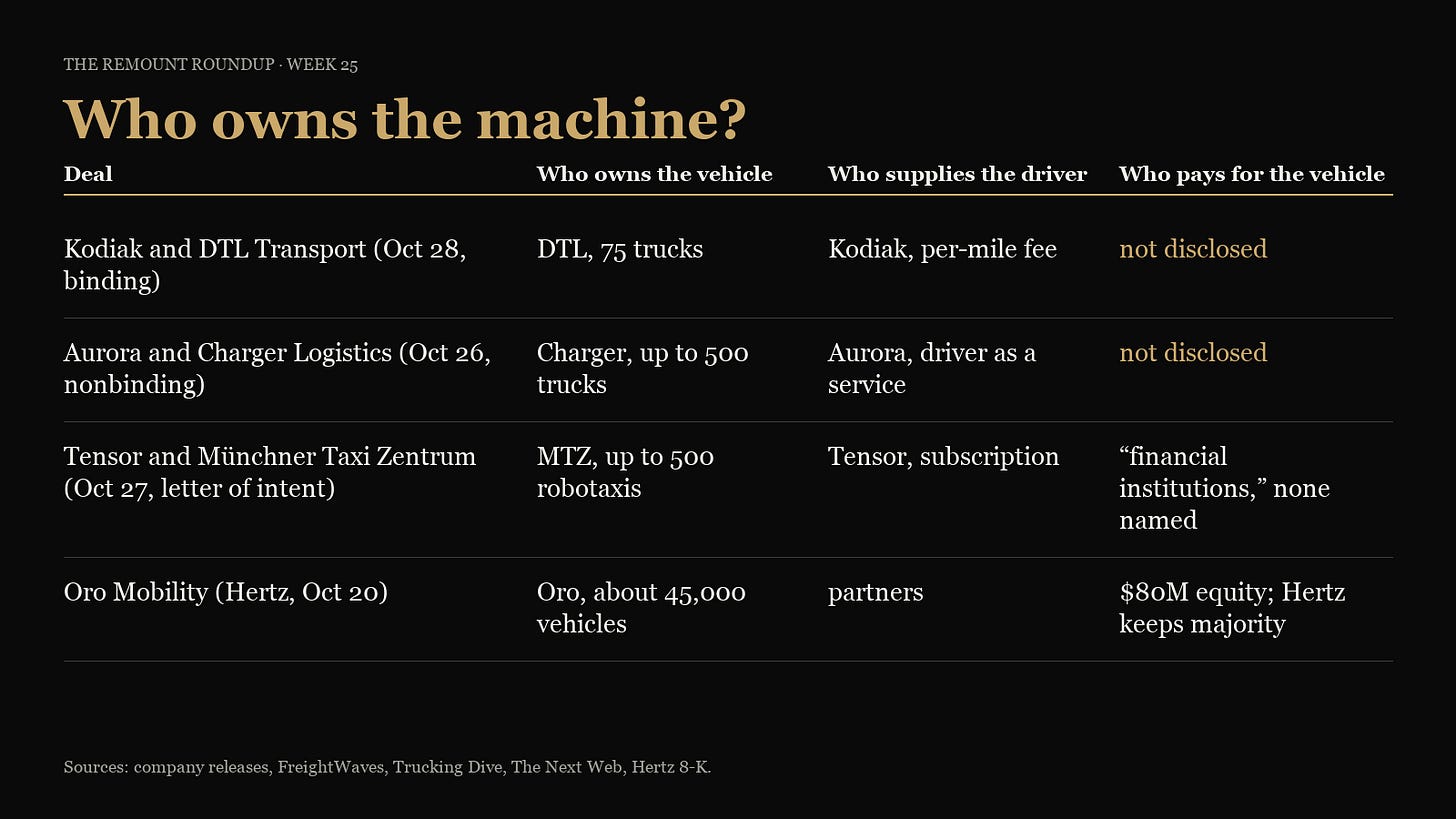
On October 28, DTL Transport, a trucking company in Fresno, California, signed a binding agreement to put Kodiak’s driving system on 75 of its trucks. DTL will own and run the trucks and pay Kodiak by the mile. Two days earlier, Charger Logistics signed a nonbinding agreement with Aurora for up to 500 trucks it would own, delivered in 2027 and 2028.
In Munich, the city’s largest taxi company signed a letter of intent with Tensor for up to 500 robotaxis it would run under its own brand, keeping its customers and its ride data and paying a subscription for the driving software. And Oro Mobility, the Hertz fleet business that runs about 45,000 rideshare vehicles, raised $80 million with autonomous fleet management as one of its three lines of business.
Every one of these owners already keeps a fleet on the road. The driving software is turning into something you subscribe to. The vehicle is turning into something a large operator owns.
The people who register with Remount look a lot like those owners, just smaller. When we filed on September 3, we had nearly 300 prospective owners, most wanting 1 to 5 cars. Nearly 450 people have registered now. We’re pre-launch, and registrations are open. Besides the man on the rig, there’s a couple in a small Mississippi town who want their first business to be one car. Those are two of many uniquely American stories.
That’s who I started Remount for. I think it’s essential that regular people have a stake in the robots that are coming to do the work, and robotaxis are the first large-scale example. What voters told pollsters in this election seems to me to back this up. In the NBC News exit poll, about 7 in 10 voters said the economic system favors the wealthy, and most still had a favorable view of capitalism. Ownership of physical AI shouldn’t sit only with large institutions and private equity funds. It must reach everyday people.
The owners are showing up. I want the man on the rig to be one of them.
Jonas
Autonomy roundup: the week’s evidence
Munich’s largest taxi company plans up to 500 robotaxis it would run itself. Tensor and Münchner Taxi Zentrum signed a letter of intent on October 27. MTZ, which has run taxis in Munich for more than 40 years, would operate the robotaxis under its own brand and keep control of its fleet, customers and data; Tensor would sell the cars and charge a subscription for its driving software. The partners say financial institutions would finance the fleets, without naming any. It depends on final agreements and on German approval for Level 4 driving, and there’s no start date. MTZ’s CEO says its professional drivers “remain indispensable,” which tells you this is a taxi company planning to own its next fleet, not leave the business. The Next Web, Oct 28 · vision mobility · Tensor and MTZ release, Oct 27
Two trucking companies sign up to own their driverless trucks. Kodiak and DTL Transport of Fresno, California announced a binding agreement on October 28 to equip 75 DTL trucks with the Kodiak Driver; DTL will own and operate them and pay Kodiak a per-mile fee, starting on I-10 between Dallas and El Paso and I-20 between Dallas and Atlanta. The release didn’t disclose the rate, the term or when the first truck runs without a driver, and DTL can’t go driverless until Kodiak closes its long-haul safety case. Two days earlier, Charger Logistics and Aurora signed a nonbinding memorandum of understanding for up to 500 trucks, delivered in 2027 and 2028, which Charger would own under Aurora’s driver-as-a-service model. Both deals split the truck from the driver the same way. FreightWaves, Oct 29 · TruckingInfo, Oct 30 · Trucking Dive, Oct 26
Hertz’s fleet company raises $80 million. Oro Mobility, which operates about 45,000 vehicles across the major US rideshare markets, announced an $80 million strategic equity investment on October 20 from a group including Cohen Private Ventures, Certares and Knighthead; Hertz keeps majority economic ownership. Oro describes itself as the ownership, orchestration and operations layer between vehicles, technology providers and demand platforms, and autonomous fleet management is one of its three business lines. Its CEO, Doria Holbrook, went deeper on the Autonomy Insiders podcast on October 29, including why a missing residual-value market makes autonomous vehicles hard to finance. That’s the question I’d most like answered for small owners. Hertz 8-K exhibit, Oct 20 · Axios, Oct 20 · Autonomy Insiders, Oct 29
Reader question: if you could own one of these machines, a robotaxi, a truck or something else, which would you pick and why? Reply and tell me.
See how the ownership side of a Cybercab works, line by line: register at remount.co and we’ll send you the dataroom link.
This newsletter is general information, not an offer to sell or a solicitation of an offer to buy any security. Any offering Remount conducts is made only to verified accredited investors through definitive documents under Rule 506(c). Forward-looking statements are estimates, not promises.