
Remount RoundupIssue 26
The Remount Master Plan Phase 2
With Tesla teasing Cybercab ownership and unsupervised autonomy, it’s time for Remount to move to our (Secret) Master Plan Phase 2. You are the first to know the strategy.
In this chaotic moment, we received great news this past week. On November 13, Tesla began inviting select customers to order a Cybercab for personal use. The price is $29,990 and deliveries are expected before the end of the year.
Now the not so great news... the invitations were extremely limited, and as reported, the terms keep the car off Tesla’s Robotaxi network, Uber, delivery apps and rental platforms unless Tesla allows it.
So the Remount vision of letting regular people own Cybercabs and participate in the income that they can generate is getting closer. I’m optimistic that we see these concepts coming together in early 2027. If not for the Cybercab immediately, then at least for the Model Y. In fact earlier this week Elon Musk told a Model Y owner who wants his car working on that network, “Coming soon. If things [go] well, may start trials next month.”
With so much progress on the Tesla Robotaxi front, we’re moving into Remount’s Master Plan Phase 2 - starting to accept enrollment for the first fleet we anticipate putting on the road!
What is an SPV and why are we pursuing this path?
One tool that lets a lot of people own a business together is called an SPV, a special purpose vehicle. It’s a small company set up to do one job. Remount’s first SPV is Robotaxi Series 1, with Robo Delivery Series 1 planned next, and both are for verified accredited investors. Robotaxi Series 1 is a Rule 506(c) offering, which means I can write about it in public but also I can’t take anyone’s word that they qualify as an accredited investor. Prospective investors will need to submit government-required documentation to verify their status as part of our enrollment process.
Accredited is mostly an income or net worth test. $200k in individual income or $1M in net worth, not counting your home, are a few of the qualification criteria. I know that leaves out a lot of people reading this and I’m expecting by early 2027 we will also have a model for many to participate in Robotaxi ownership via their own LLC, which is not subject to the same rules as an SPV.
With an SPV, do you own the car? No. In an SPV you own a share of a company, and the company would hold title to the cars and sign the contracts. A share like that is harder to sell than just selling a car. With our SPV model, we forecast making regular payments to members based on income that the Robotaxis generate, but it’s also possible you could lose some or all of your investment in the SPV if things don’t work out as forecast. Remount Corporation is the manager of Series 1. Its fees will be listed in the offering documents.
The letters SPV don’t tell you much, because there are two kinds.
One type of SPV is a bet on a price. The company holds shares in a startup, or a painting for example. You make money only if someone later pays more for it than you did, which of course might never happen. Many of the SPVs you see circulating these days are this type of vehicle. If you had been an early purchaser of Anthropic stock SPVs a few years ago, you are probably a happy investor today.
The other type of SPV is a small business in a wrapper. Say the company owns a building or a farm and collects the rent. It’s built to pay investors from what’s left after costs.
What happens if nobody ever buys my share? Ask that and you can tell them apart. In the first kind, you wait. In the second, the business is built to pay you anyway, if it earns. I’m not saying either one is better, but it’s important to understand that a robotaxi fleet is built to be the second kind of SPV.
A few things would have to be true before a Robotaxi SPV pays anyone. Tesla would have to let cars it doesn’t own work on its network. It would have to offer cars and terms to fleet owners. Cities and states would have to allow the cars to carry paying riders, and someone would have to insure them. Then the cars would have to earn more than they cost. So despite all our forecasts and models, nobody yet can tell you with certainty how much a fleet like this would earn, or whether it will.
In the next few weeks, we will be launching a new version of our website where you will be able to qualify as an accredited investor and enroll in Remount Robotaxi Series 1, and we expect our second SPV, Remount Robo Delivery Series 1 will be launched shortly afterwards. We have some exciting opportunities emerging in the Robo Delivery space that we look forward to sharing with you.
Before You Pay Anyone
When you register at remount.co, you get access to our dataroom, and from there you can schedule a call with me. I’ve talked to dozens of you over the past few months, but a conversation I had this past week was the most troubling. The potential investor told me about a Cybercab ownership pitch he’d heard. As he described it, $5,000 bought a spot in a group the seller called a cohort, plus a blueprint for running a fleet and some contacts. He was told people in the cohort were getting ready to receive cars in early December. When our prospective investor called back with questions, he said, the salesman hung up.
I don’t know whether he could have gotten the $5,000 back or if it was some scam trying to leverage the interest in this space to grab a quick buck. It’s the first thing I’d have asked. Tesla is taking orders by invitation, for personal use, and has published no terms for fleet owners.
This is the test I’d use. Be very careful with anyone other than the carmaker who wants money today that you cannot get back, for a place in line. Tesla’s own order takes a $1,000 non-refundable deposit, but Tesla builds the car.
Hold us to the same test. We don’t build the car, so before you send us a dollar, find the page in the offering documents that says how you get it back.
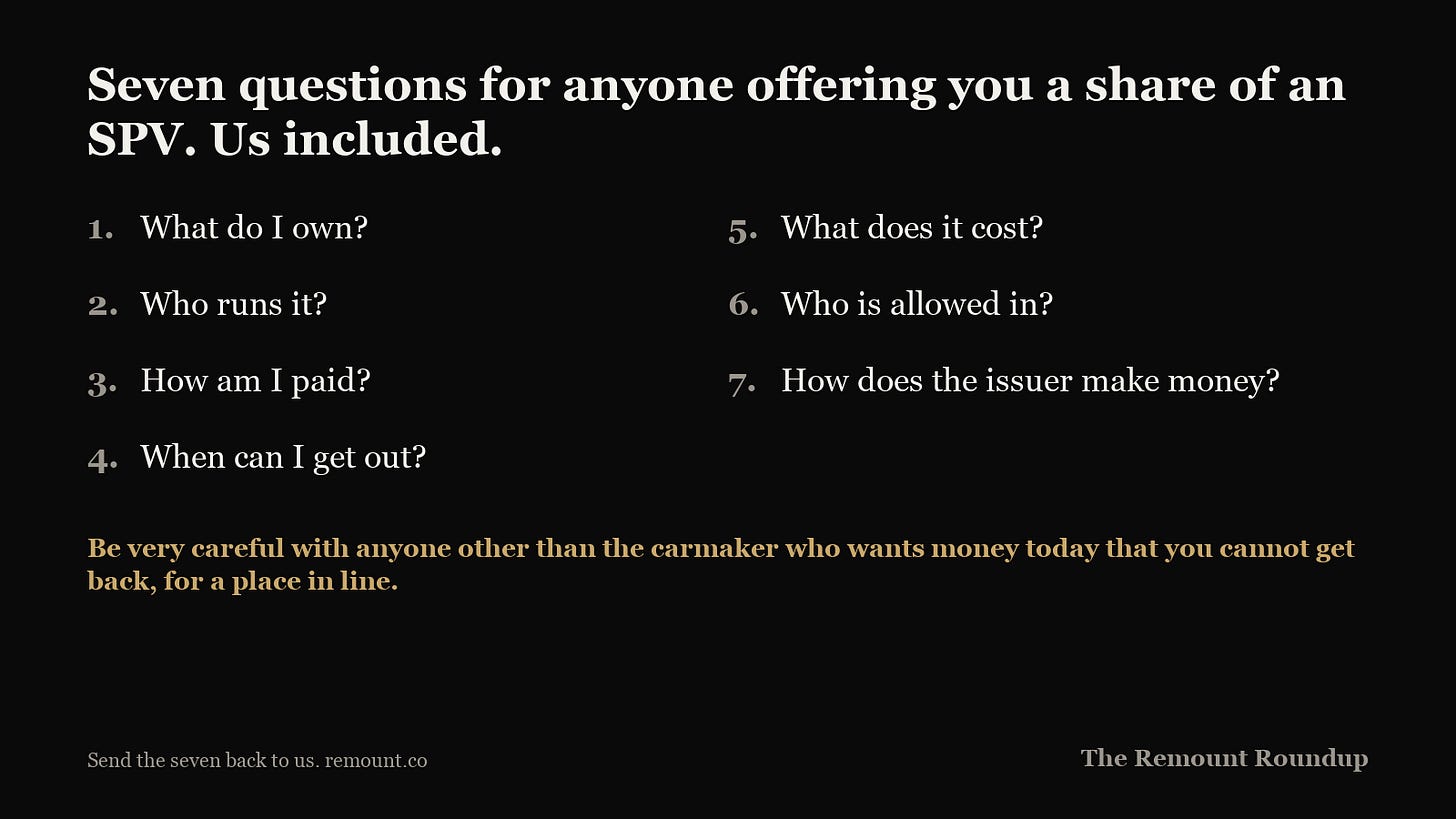
I’d put seven questions to anyone offering me a share of an SPV. What do I own? Who runs it? How am I paid? When can I get out? What does it cost? Who is allowed in? How does the issuer make money? With Remount’s SPVs, I have to check your paperwork before you can invest, so check ours first. Send the seven back to us. Each answer should be in the offering documents when they reach you. If one is missing, ask us before you sign anything.
Jonas
Autonomy roundup: the week’s evidence
Tesla is taking Cybercab orders by invitation, for personal use. On November 13, Tesla said select customers are being invited to buy a Cybercab for personal use. The order screen shows $29,990 before taxes, a $299 a month Autonomy Subscription required to operate the car, a $1,000 non-refundable order deposit and delivery estimated for December 2026. The screen Tesla posted shows delivery in Austin. No customer delivery has been announced. As reported, the subscription terms say the car won’t run without an active subscription. They don’t allow Robotaxi network, Uber, delivery or rental use unless Tesla allows it, and Tesla can change the subscription price on one month’s notice. We haven’t read the agreement itself. Tesla @robotaxi on X, Nov 13 · Not a Tesla App, Nov 14 · Not a Tesla App on the terms, Nov 14
Musk says owner cars on the Robotaxi network are “coming soon,” with trials that “may start” next month. On November 16, Elon Musk replied to an Austin Uber driver who uses a Model Y with Full Self-Driving and had posted that he’d rather send the car to work on Robotaxi without him. Musk wrote, “Coming soon. If things well, may start trials next month.” He gave no city and no terms. There’s no firm date, and he said nothing about Cybercabs or fleet companies. Tesla has published no terms for owners to earn on its network. It’s a reply on X, and he wrote “may.” Musk on X, Nov 16 · Teslarati, Nov 16
The SEC is asking whether passing an exam should make someone an accredited investor. On September 30, the SEC issued five notices asking for comment on new ways for a person to qualify as accredited without meeting the income or net worth tests. One (Release 33-11445) is an exam FINRA would build, about 75 multiple-choice questions over about two hours, open to anyone 18 or older. Comments are due December 4, 2026. Nothing is final and the exam doesn’t exist yet, so nobody qualifies this way today, and it doesn’t open Robotaxi Series 1 to anyone today. The two tests most people use are unchanged: income over $200,000 (or $300,000 with a spouse or partner) in each of the last two years and expected again this year, or net worth over $1 million, alone or with a spouse or partner, not counting your home. SEC Release 33-11445, Sept 30 · SEC, Accredited Investors
Reader question: which of the seven questions would you ask first, and what’s missing from the list? Reply and tell me.
See how the ownership side of a Cybercab works, line by line: register at remount.co and we’ll send you the dataroom link.
This newsletter is general information, not an offer to sell or a solicitation of an offer to buy any security. Any offering Remount conducts is made only to verified accredited investors through definitive documents under Rule 506(c). Forward-looking statements are estimates, not promises.