
Remount RoundupIssue 19
The customer owns the truck
Trucking just split the driver from the vehicle. Aurora licenses the driver, its customer owns the trucks, and a leasing arm is ordering 2,500 electric trucks, mostly Tesla Semis. Cars come next.
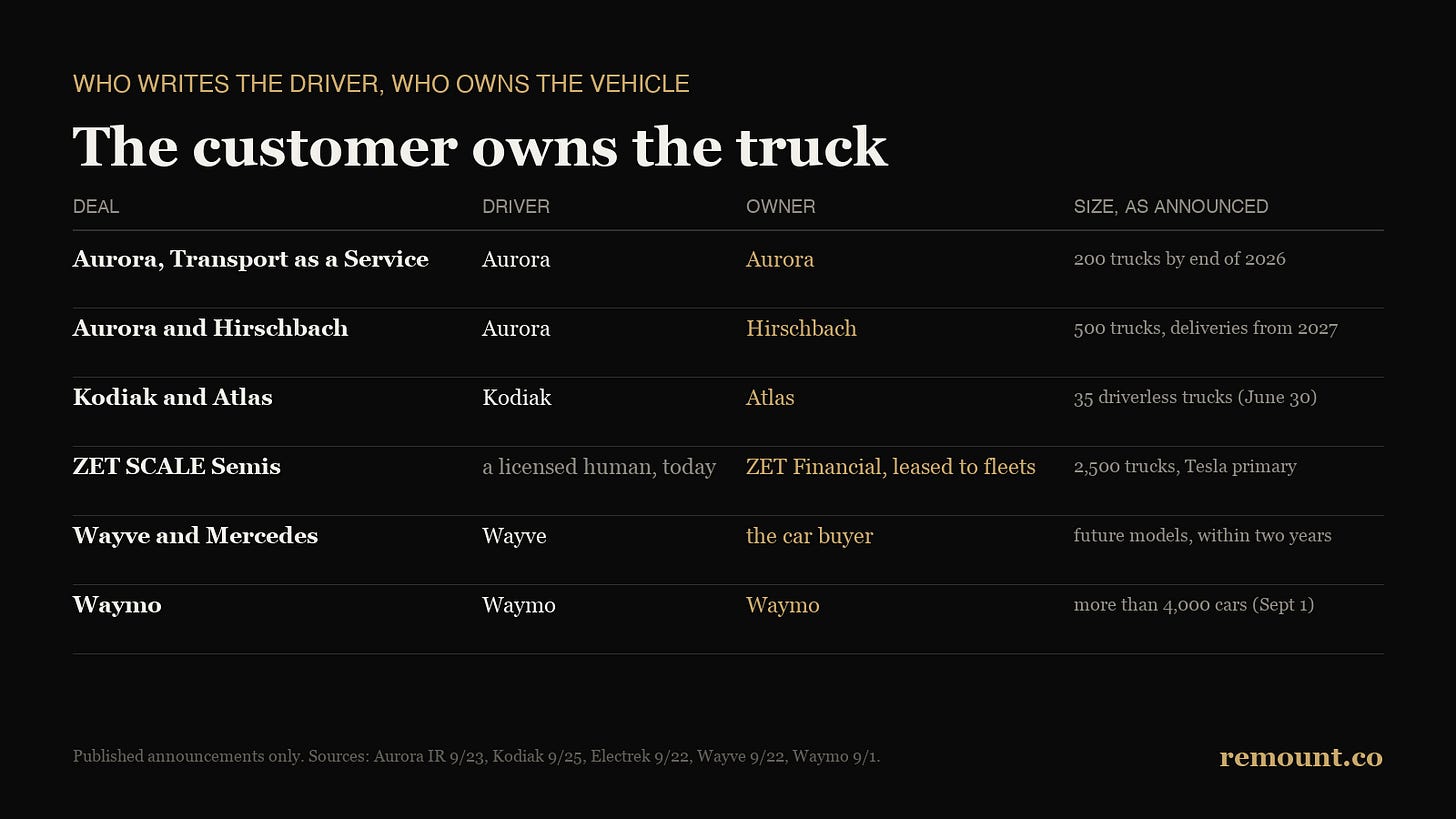
Last Monday, on two different calls, two people asked me nearly the same question. Who owns the car, and who carries the loan? It’s the right question, and this week the clearest answer came from trucking.
On September 23 Aurora held its investor day and set a goal of more than 30,000 driverless trucks by 2030. The fleet number got the headlines. The line I read twice was about Hirschbach, a carrier that intends to run 500 Aurora-driven trucks that it owns and operates itself, with deliveries starting in 2027. Aurora calls this Driver as a Service. Aurora supplies the driver and the customer owns the truck. Aurora also runs a second model, Transport as a Service, where it owns and operates the trucks and sells the capacity, and it expects to finish this year with 200 driverless trucks that way. Both models live inside one company, side by side.
Kodiak got there first. In December 2024 it put its driver into trucks owned by Atlas Energy Solutions, and by the end of June Atlas owned and operated 35 driverless trucks hauling in the Permian Basin. Last Friday Kodiak named Dallas to Houston, 219 miles of I-45, as its first long-haul driverless lane, with unsupervised service targeted for the end of this year.
Then there’s Tesla. At its Semi event in Nevada on September 24, Tesla said the Semi is now in volume production at a plant sized for 50,000 trucks a year. Two days earlier a shipper alliance called ZET SCALE, whose founding shippers include Microsoft and PepsiCo, named Tesla the primary supplier for an order of 2,500 electric trucks. Its financing arm, ZET Financial, places the orders and leases the trucks to fleets through a program built to take residual value risk off their books. The Semi you can buy today still needs a licensed driver in the cab. On Tesla’s July earnings call Musk said he expects self-driving to work on the Semi “probably around the end of this year or early next year,” and Tesla has missed autonomy dates before. Even so, the ownership side of that future is already being built, and it’s being built by people who are not Tesla.
California is paying to help. The state’s HVIP program lists a $120,000 voucher for a Class 8 Semi, $150,000 for drayage work, and the new California Clean Fuel Reward can add more for qualifying small fleets. The state wants these trucks on the road and is happy for a carrier, not the manufacturer, to be the one who owns them.
Cars are drifting the same way. On September 22 Wayve signed Mercedes-Benz to put its AI Driver into future Mercedes models within two years. That’s driver assistance for people who buy their own car, not a robotaxi. Still, the company that writes the driver and the company that owns the vehicle are no longer the same company.
Here’s why this matters to anyone thinking about owning a robotaxi. Once the driver is software someone licenses, the vehicle becomes an asset that someone else can own, as long as a network sends it work and somebody keeps it charged, cleaned and fixed. Trucking got there first because carriers already own trucks and already know how to finance and maintain them. Robotaxis don’t have that kind of owner yet. Waymo owns its cars, and Tesla runs its robotaxi service on its own cars today.
Tesla’s fleet interest form asks whether you want to buy fleet vehicles, which tells me Tesla is at least thinking about it. Nobody I’ve talked to has heard from Tesla about allocations, and I won’t guess at terms. What I can tell you is what Remount is getting ready to be: the carrier in this picture, owning Cybercabs and running them with a driver someone else built. Hirschbach didn’t have to build a driver to own an autonomous truck, and our owners won’t have to either.
Regards,
Jonas
Autonomy roundup: the week’s evidence
Aurora laid out its 2030 plan on September 23: more than 30,000 driverless trucks and a multi-billion-dollar revenue stream. It expects to exit 2026 with 200 driverless trucks under Transport as a Service (Aurora owns and operates). Hirschbach intends to operate 500 trucks under Driver as a Service (the customer owns and operates), with truck deliveries starting in 2027, and Aurora says it is negotiating more DaaS deals. Second-generation hardware cuts cost by more than half. Aurora-driven trucks are running at an annualized rate above 225,000 miles a year, which it says is more than double a conventional truck. https://ir.aurora.tech/news-events/press-releases/detail/152/aurora-outlines-2030-vision-to-scale-to-30000-driverless-trucks-at-analyst-and-investor-day
Tesla put the Semi into volume production on September 24, at a 1.8 million square foot plant in Sparks, Nevada built for up to 50,000 trucks a year. Electrek puts the price at $260,000 for Standard Range and $290,000 for Long Range. Two days earlier the shipper alliance ZET SCALE (founding shippers include Microsoft and PepsiCo) named Tesla primary supplier for 2,500 electric trucks, with Kenworth, Volvo and RIDE as secondary suppliers, placed and leased to fleets by its financing arm, ZET Financial. Today’s Semi requires a driver; Musk said in July he expects self-driving on the Semi around the end of 2026 or early 2027. https://teslanorth.com/2026/09/25/tesla-semi-high-volume-production/ https://electrek.co/2026/09/25/tesla-semi-volume-production-launch-nevada-factory/ https://electrek.co/2026/09/22/tesla-semi-2500-truck-order-zet-scale-largest-us/ https://electrek.co/2026/07/27/musk-tesla-semi-self-driving-year-truckers-jobs-safe/
Kodiak named Dallas to Houston as its first long-haul driverless lane on September 25: 219 miles of I-45, unsupervised service targeted by the end of 2026, and intervention-free end-to-end deliveries on the route since August. Its driver has been running in customer-owned trucks since December 2024; as of June 30, Atlas Energy Solutions owned and operated 35 driverless Kodiak-equipped trucks. https://www.globenewswire.com/news-release/2026/09/25/3369124/0/en/kodiak-ai-names-dallas-houston-as-long-haul-driverless-launch-lane-consistently-completes-intervention-free-end-to-end-deliveries.html
Reader question: if you run trucks, would you rather own a driverless truck and license the driver, or buy the freight capacity and let someone else own the truck? Reply and tell me why. I’d like to hear from people who have financed a fleet.
See how the ownership side of a Cybercab works, line by line: remount.co/modeler
This newsletter is general information, not an offer to sell or a solicitation of an offer to buy any security. Any offering Remount conducts is made only to verified accredited investors through definitive documents under Rule 506(c). Forward-looking statements are estimates, not promises.