
Remount RoundupIssue 21
Waymo just borrowed $5 billion
Waymo took on its first debt last week, from PIMCO, Blackstone and eleven others. Lenders underwrite cash flow, not stories. That changes who can own a robotaxi fleet.
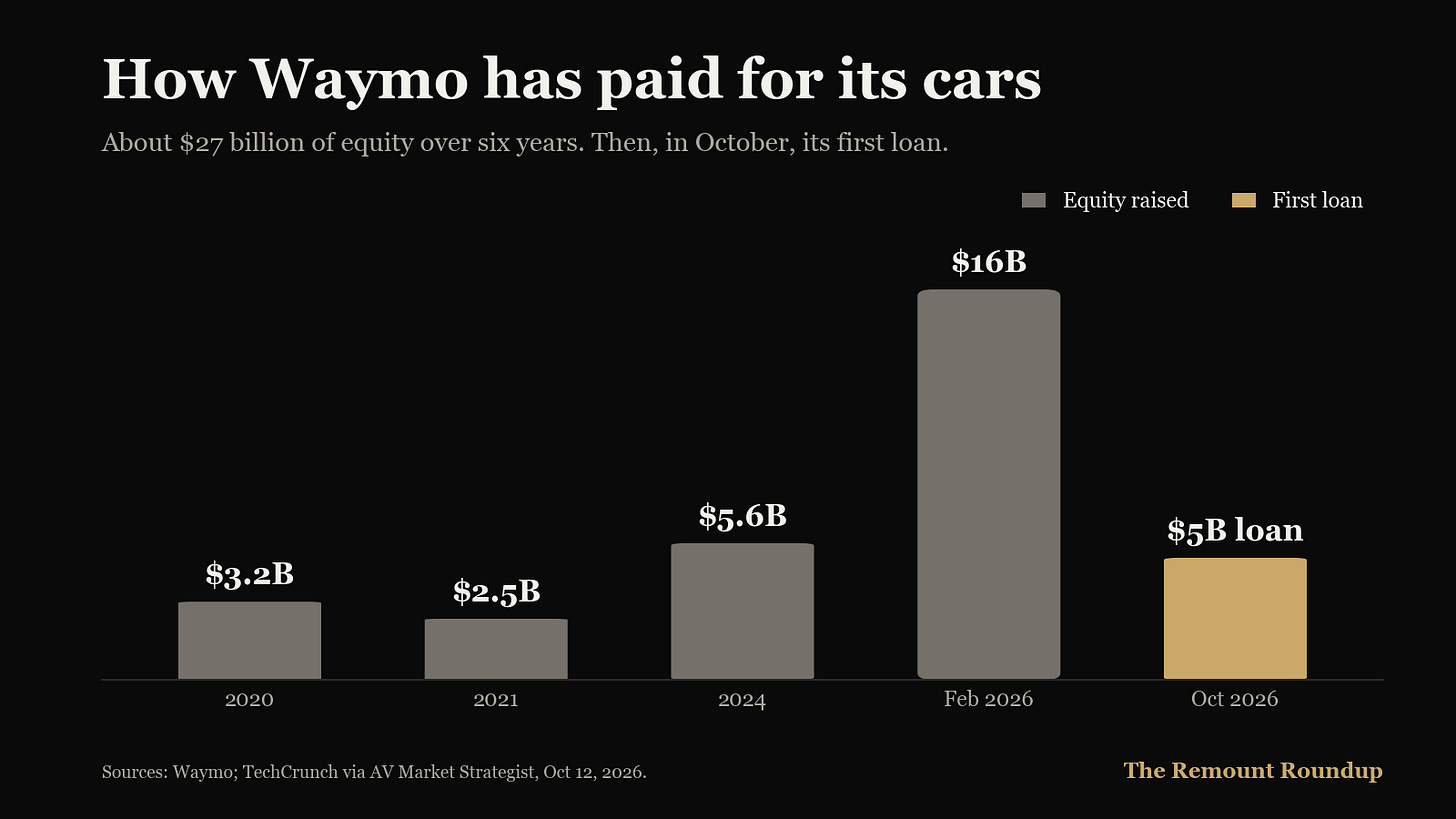
Last Thursday, October 8, Waymo closed a $5 billion term loan. It is the first money the company has ever borrowed. Until now Waymo paid for its cars the way you pay for a moonshot: about $27 billion of equity over six years, most recently $16 billion in February at a $126 billion valuation.
The lender list is the part I keep rereading. PIMCO, Blackstone and Sixth Street led it. Capital Group, Loomis Sayles and T. Rowe Price came in behind them, then seven more, including Apollo, Oaktree and Fidelity. Goldman Sachs ran the book. Bloomberg reported that Waymo went out in September looking for a little over $3 billion and ended up at $5 billion.
Equity investors buy a future. Lenders buy repayment. A credit fund doesn’t need Waymo to win the category. It needs the cars already on the road to earn enough, reliably enough, to cover the interest every quarter. When thirteen of the biggest credit investors in the world sign up for that, they are saying a robotaxi fleet now looks like something that produces cash, not a science project.
Tesla is heading the same way from the other side. On September 29 it filed for $30 billion of new credit lines with Citibank and Wells Fargo. The filing doesn’t earmark the money for any product, and Tesla says it doesn’t plan to draw on it this year, so I wouldn’t read too much into it. Still, the two companies building the most robotaxis both lined up big debt within ten days of each other.
The truth is that debt follows proof. Trucks, aircraft and rental cars all went through the same steps. First the company that runs the machines owns them outright, because nobody else will take the risk. Then lenders learn how the machines earn and start financing them. After that, ownership spreads out to leasing companies, equipment funds and owner-operators. Many of the jets you fly on belong to a leasing company, not the airline painted on the side.
Robotaxis just reached the second step. The cars still sit on Waymo’s balance sheet, and this loan pays for more of them. Waymo’s new silver Ojai is ramping at its plant in Mesa, Arizona, and is due to start carrying riders in San Francisco, Los Angeles and Las Vegas in the coming weeks.
Cybercabs aren’t there yet. Here at Remount, we’re working out the best mix of equity and credit to help hundreds of investors, large and small, get into the business of owning Cybercabs. Waymo can pull in big debt, but Cybercabs don’t have public operating results yet, so the very first fleets will have to be largely equity. We’re talking with a number of debt providers who want to hear more, and I think it will take 6 to 12 months of operating results before we can follow the kind of debt financing Waymo is pioneering now.
Waymo’s lenders just put a price on what a robotaxi fleet earns. Now the question is who gets to own it.
Jonas
Autonomy roundup: the week’s evidence
Waymo closed its first debt. On October 8 Waymo announced a $5 billion term loan, led by PIMCO, Blackstone and Sixth Street, with Capital Group, Loomis Sayles, T. Rowe Price and seven more lenders, and Goldman Sachs as sole lead bookrunner. Waymo says the money will speed up the expansion of its driverless ride-hailing service in the US, where it reached its fifteenth city last month, and abroad. Waymo · The Next Web, citing Bloomberg
Where the money goes: more cars. Waymo’s silver Ojai, its next vehicle, is ramping up at the company’s integration plant in Mesa, Arizona, and will begin serving riders in San Francisco, Los Angeles and Las Vegas in the coming weeks, with more cities after that. No unit counts were given. Ride AI, Oct 13
A fleet financier handed the cars to its drivers. Moove, Uber’s largest fleet partner worldwide and an operator of Waymo robotaxis, said on October 8 that it is ending its Nigerian business a month after Uber shut down there. Instead of repossessing, it is transferring full ownership of eligible cars, worth about ₦35 billion, to the drivers who were paying them off, with no further payments owed from October 1. More than 9,000 Nigerians used Moove’s drive-to-own and rental products. Drive-to-own is the oldest version of the idea that the person doing the work can end up owning the machine. Nairametrics · AV Market Strategist, Oct 12
Reader question: if a robotaxi fleet is now something lenders will finance, what would you want to see before you owned a piece of one? Reply and tell me. I read every answer.
See how the ownership side of a Cybercab works, line by line: register at remount.co and we’ll send you the dataroom link.
This newsletter is general information, not an offer to sell or a solicitation of an offer to buy any security. Any offering Remount conducts is made only to verified accredited investors through definitive documents under Rule 506(c). Forward-looking statements are estimates, not promises.